Monday, May 31, 2010

Week 32: Well, that's all everybody. Thanks for coming.


I'll keep my answer to last week's question pretty brief. Pretty much, from what I was able to dig up on Criss, he used to make claims to having these supernatural powers, but as his popularity increased, his image shifted to more of just an entertainer than a psychic. He doesn't really make claims that he has these powers, it's more something that he wants the audience to assume.


This week has been all about the controversy of alternative medicines. Do they really work? If they don't, should they be allowed to sell them? Can they be harmful? Why doesn't the FDA approve them. I'm just going to begin by saying that when in comes to alternative medine, I'm a major skeptic. I don't believe that any of what is being sold can cure you, I don't think footrubs will make negative energy leave my body, and I don't believe that placing a bunch of tiny needles in my body will help my chi. My opinion, however, doesn't seem to be a common one because people are still buying these products that aren't proven to work. I personally don't understand why people waste their time, but clearly there's something drawing them to the products.


So the question is, is okay to sell these placebos? Some would argue yes because if someone's dumb enough to pay for it, that's their own fault. Well, that seems unfair because I honestly don't know enough nor do I have the time to learn everything about what works and what doesn't. It seems like these companies are cheating the public because they are taking advantage of the fact that so many people know so little about medication. There's no way something that has been diluted down to where it is nonexistant would work, but there are plenty of people out there that don't know that that's what "homeopathic" means.


There also hasn't been enough research to prove that every alternative drug that is taken is 100% safe to be consumed. Sometimes they react with a prescription and harm, or in some cases even kill the consumer. When there isn't enough research on something, that seems like a red flag to me. It should be saying to our government "This isn't ready for public consumption yet", not "Oh what the hell, it's their choice to risk it." So maybe hospitals should stop offering this phony medicine in an extra wing of the building just to make a quick buck. Maybe the government should decide that the drug isn't ready for the public. Maybe the consumer should stop buying into that kind of thing. Yeah, that would be nice.


Sources:

Homeopathy. Photograph. The Penzance Horse. Web. http://www.thepenzancehorse.com/2009/NEWSLETTERS/JULAUG09/homeopathy-stockexhng.jpg.


That Mitchell and Webb Look: Homeopathic A&E. Youtube. Web.
http://www.youtube.com/watch?v=HMGIbOGu8q0.

Sunday, May 9, 2010

Week 30/ 31: Magic!

Last week I wanted to know what happened to Rwanda after the genocide of 1994. After the Patriotic Front defeated the Hutu army, Rwanda was still faced with poverty, destruction, and major diseases like cholera. The Front began rebuilding from scratch, insuring that the MRND (the ruling party during the genocide), would never be able to regain power. Surprisingly, with little international aid, the RPF completely rebuilt the government and the economy from scratch, a feat that seems really difficult in hindsight. The first presidential elections were held in 1994.

These past two weeks we shifted gears quite a bit. We finished off the Rwandan discussion towards the beginning of the week, and we're now looking at the principles of magic. We have begun to analyze what makes magic possible, and why our minds allow us to see things that aren't there. All magicians follow the 7 main basic principles of magic:

1. Palm- concealing an object
2. Ditch- Removing the object
3. Steal- take a needed object inconspicuously
4. Load- get the object into position
5. Simulation- pretend to do something to distract the audience
6. Misdirection- lead the audience in a completely wrong direction
7. Switch- swap the two objects

Voila! Magic. Fortunately, it's much more complicated than that. All this is occurring within seconds of each other, keeping the audience completely in the dark as to what's going on. The main illusion that the magician creates is really just a trick of the mind. Nothing is occurring that bends the laws of nature, but the audience allows for our minds to be tricked into thinking it does. Magic is completely reliant on human psychology. For example, the Barnum Effect is the ability to convince someone that something completely false is entirely true.

Most of the tricks performed by magicians require the audience to not be at full attention, where misdirection comes in. Misdirection is used to point the audience exactly where the magician wants them to look in order to continue the trick undetected. It might be a simple point of the finger or something even more subtle and difficult to pick up. Often, misdirection is the hardest thing in a trick to spot when it is occurring because it is the most crucial in any illusion. If it is not carried out correctly, then the trick can be ruined.

Over the years, magic has had the opportunity to evolve with technology. As science becomes more in-depth, magic has the ability to grow and become more elaborate. Technology is often used by many magicians as a means of making their tricks more impressive and even more difficult to figure out. For instance, in the video we watched, a magician used a computer program where he was able to plot out an extensive illusion that made it appear that he moved a mountain. Technology that wouldn't have been readily available 20 years ago can now help illusionists perform what seems to be the impossible.

What I found most interesting was the relationships between magicians and "psychics". I had no idea they hated each other. I didn't even know that there was much of a difference between the two, but as James Randi explains, magicians let you know from the start that they are going to try to fool you. They let you know their performance isn't real, leaving it up to you to figure out how it is done. "Psychics" (note the quotation marks) on the hand, claim that their power is purely supernatural and that what they perform cannot in any way be replicated by mortals. People like Uri Geller make claims that they have unobtainable gifts.

So what's the harm in that? Why does it matter if someone claims to have these paranormal abilities? Well, for one thing, if a magician and a psychic perform the same show, who are people more inclined to go see. Probably the guy who claims his magic is real, not some parlor trick. It makes sense because we go to magic shows to see magic, so naturally we want to see those guys that can read minds and do things that normal humans can't. Therefore it not only takes business away from magicians, but also makes them look inferior. That is why magicians like James Randi spend so much time trying to expose frauds like Uri Geller.

But it still seems strange that people would believe claims made by people like Geller. Science proves that what they do is impossible, yet people still believe it. It's because we want to be amazed. We let our minds get fooled because we want magic and the impossible to be real. A magician never reveals his tricks because deep down we don't want him to. Most of us like to keep the mystery a secret because otherwise it loses its impressiveness.

The movie alluded quite often to Criss Angel. I am familiar with a lot of his work, but I have no idea where he stands on the whole "magician vs. psychic" debacle. Does he claim to have supernatural powers like Uri Geller? Iunno. I'd like to find out, though because he seems to be one of the most recognizable faces in the magic industry currently.

Sources:
Penn and Teller. Photograph. Vox. Web. http://a0.vox.com/6a00c2251d306b604a00cd978a2c98f9cc-320pi.

Uri Geller. Photograph. Crockatt and Powell. Web. http://crockattandpowell.com/blog/uploaded_images/Uri-744501.jpg.

Sunday, May 2, 2010

Week 29: Ghosts of Rwanda

Last week I wanted to read up a little more on the origins of the Israeli-Palestinian Conflict, so I could better understand the opinions of both sides of the argument. I didn't know that the conflict originated back in the early 19th century when the Ottoman Empire was under control of Palestine. At that time, the conflict was completely religious based and had nothing to do with nationality. After the Ottoman Empire was defeated in World War I, it was unclear to whom the land should belong. The Jewish people thought they deserved to have the land back, while the Muslims thought since they already occupied it, they deserved it. Thus the Conflict began. Matters only became worse when the British Mandate of Palestine forced many Palestinians out of their homes, making them bitter towards the Israeli people.

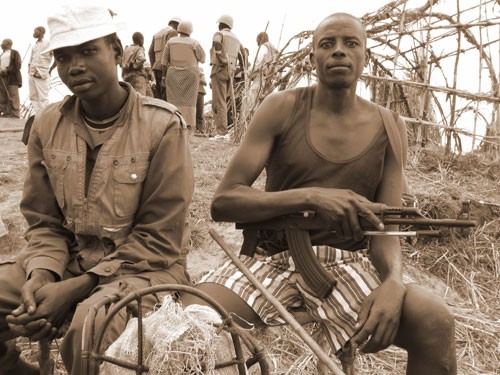
This week we began watching the film "Ghosts of Rwanda", which focuses on the Rwandan Genocide of 1994. I had to do some background research to completely understand what was going on. It appears that Rwanda was a Dutch territory until 1962. At that point, they granted full power and control to the Tutsi people, who, even though they were the minority, were the native people of Rwanda. This angered the Hutu, who were foreign people but made up the majority of the population. In 1994, the plane of a Hutu president was shot down. In response, the Interhamwe ordered a large amount of machetes which they then used to slaughter over 800 thousand Tutsi and moderate Hutu political leaders.

The documentary takes a western perspective of Americans who witnessed the genocide and survived. It was haunting to hear the amount of violence that went on and the brutality of it all. The UN tried to offer protection, but found it too overwhelming, and they had to pull out and leave all those people to fend for themselves. Although it doesn't seem fair that they would do that, at the same time it makes sense. They were putting soldiers lives' at risk for something that seemed inevitable. Just saving the Americans isn't fair at all, but if Tutsi people were loaded into a car or onto an airplane, it puts the lives of everyone at an even greater risk. They had to save as many people as they could, and that unfortunately meant leaving a lot of people to die.

A lot of parallels can be drawn between the Rwandan Genocide and the Israeli-Palestinian conflict. For one thing, the major causes for violence among both occurrences were disputes over land ownership as well as racial discrimination. That being said, what is going on in Israel is a fight between two equally guilty parties, while the Rwandan genocide was just one side exterminating the other.

I found it interesting that in my research I read that Rwanda has made a full recovery and is now a model for other third-world countries. My interest has been peaked. I'd like to know how long this transformation took, what ethnic group holds office, and what makes them a role model. I hope by this next week I'll be able to answer all of those.

Sources:

Ghosts of Rwanda
. Photograph. Content Reserve. Web. .

Interahamwe. Photograph. All Things Pass. Web. .