Sunday, November 22, 2009

Week 10: Done with Documentaries


Last week, as we were watching Michael Moore Hates America, I noticed that I wasn't looking for every flaw in Mike Wilson's logic; I wasn't looking for every soundbite he used; and I wasn't looking for any type of fallacy that would make me think less of him. This week, I decided to pay a little more attention to the movie, and in all honesty, I still didn't find much. The only conclusions that i could draw are either he really tries to avoid any misleading notions, or I just don't pick up on it. It's a lot easier to dismiss something like that when it's done with good intentions. If I was a fan of Moore, sure I'd pick up on more of the blatant attacks and misleading information, but as it stands, Wilson just seems more innocent and appealing.

This week we finally finished up on the film Michael Moore Hates America and had a discussion on what made Mike Wilson so much more appealing than Michael Moore. What stuck out is Wilson's attempt to be as distant from Moore's film style as possible. He apologizes when he accidentally uses misleading information, he keeps as many of the facts in context as possible, and he just seems like a nice guy. What made Moore such a turn-off was his ego, he always came off as this jerk who thought he was saving America. Another was his appearance. He's this fat, rich slob that thinks that as long as he wears a baseball cap he can relate to the average American. Finally, his film making tactics are a major turn-off. He has this belief that it doesn't matter how much he tweeks something as long as it gets his point across, kind of the Machiavelli of movie-making.

Wilson, on the other hand, possesses none of these traits. He's a humble, average American man that actually wants to better the American people rather than scare them and make their lives miserable. Wilson doesn't convince himself that he has to be the voice of the people; instead, his job is simply to enlighten those who have been sucked in by Moore's misleading scare-tactics. Wilson also has another advantage: Penn Jillette. Penn can be summed up easily through a quote by Bob Dylan that he uses in the movie, "Fearing not that I may become my enemy, in the instant that I preach." He's this down-to-earth guy that can sniff out BS from a moment away. He's the reason Wilson didn't resort to using the same tactics as Moore while making this film.

Not that our documentary study is coming to a close, I'd be interested in seeing what direction my group heads in filming our documentary. Will we take the easy way out like Moore and make things look how we want them to? Perhaps we'll go a more "hands-off" approach, like A Perfect Candidate or This Divided State.

Sources:

Michael Moore "Loser" Photograph. Smh.com.au. Web. .

Michael Moore Hates America. Photograph. Arcade Action. Web. .

Sunday, November 15, 2009

Week 9: Dislike Mike


So last week we looked at This Divided State and watched a large amount of opposition to Michael Moore as he he gave a speech at Utah Valley State University. I was curious to see how common this was for speakers to experience after I learned about a similar occurance that happened to Dick Cheney. The only difference between the two is that BYU is known for their conservative viewpoint, yet opposition was still heard towards Cheney. When "speech protest" is typed into Google, a large number of results appears. It seems understandable, even though every American has the right to their own opinion (even if they are a leader of a cop-killing terrorist group that wants to give a speech at the University of Massachusetts.) There are plenty of Americans that would argue that certain free speech needs to be censored, so long as it's not their's.
So this week we started Mike Wilson's masterpiece, Michael Moore Hates America. I thought Moore angered me before, but this some of what's in this movie just outraged me. Specifically, when Wilson approached Moore and Michael just attacked him for the documentary, when it is not slandering Moore any more than Michael did to the victims of his films. In fact, it's interesting to see how Wilson tries to avoid fallacies as much as possible. If he notices himself doing it, he points it out to his audience, which is much more respectable than Moore's techniques. Michael misleads the audience, and then when questioned about it, he convinces everyone (including himself) that everything happened just as he depicted it. Wilson has his producer and Penn Jillette hold him accountable for any propaganda that he might accidentally

I must admit, I'm enjoying the film a little more than I should be. Even though Wilson appears to avoid these fallacies as much as possible, they're still there. This man is using Moore's own techniques against him, but since my opinion of Moore was so negative from the start, it's hard to not side with sweet, innocent Wilson on everything. That's a very positive thing Mike Wilson has going for him. No matter what he's doing, Wilson has this innocent, common man appeal that Moore strives so hard to portray, but unlitmately fails doing. Perhaps that's why I find myself rooting for Mike Wilson.

As this week continues, I'd like to look a little further into how honest ans innocent Mike Wilson really is. I'm sure that most of my opinions on him won't change as we wrap the movie up, but there might be a few fallacies that'll slip through the cracks if I'm not looking specifically for them.

Sources:
Michael Moore Hates America. Photograph. The Veiled Chameleon. Web. <http://www.veiled-chameleon.com/weblog/httpdocs/images/blogcontent/michael_moore_hates_america.jpg>.
Penn Jillette. Photograph. Downshore Drift. Web. <http://www.downshoredrift.com/.a/6a00d83451d87169e2011278d5491d28a4-500wi>.
"Rare Protests at Brigham Young Over a Planned Cheney Appearance." NY Times. Web. <http://www.nytimes.com/2007/04/11/us/11byu.html>.


Sunday, November 8, 2009

My Political Party (Week 8)


So last week we looked at the local campaigns, and I couldn't help but wonder how informed the average American is on the actual issues. Based on the research I found, an overwhelmingly large amount of Americans simply vote on which party they think represents them, instead of looking at the actual issues. I polled my friends, family and people from my church and discovered that 9 out 10 of those who voted in the recent election knew next to nothing on the issues.

After some discussion in class this week about political issues, we all took tests to determine our political parties. Expecting to be more of a libertarian conservative, I was blown away that I was the exact opposite. Most of the class had similar reactions. It just goes to show that we as Americans aren't educated on our political viewpoints as well as we need to be. Washington feared that a party-system would be detrimental to society and would split the country. His ideas were a little extreme, but try to think about a government where the candidates aren't affiliated with a party. Would there be so much bitterness between voters? We might even start paying attention to the real issues if we take out the ability to blindly choose sides. Are political parties even that important? Not really.

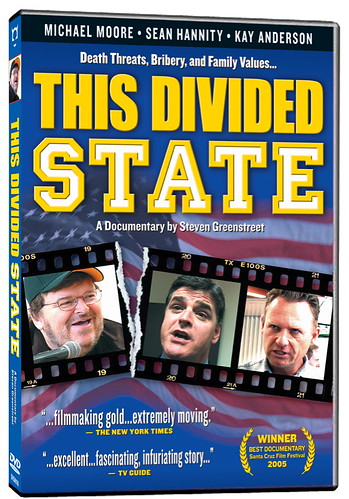
Okay, so this week we started to watch This Divided State, which focused on events that occured at Utah Valley State College in 2004. The controversy occurred when the student board asked Michael Moore to speak at their university. The citizens of Utah, being a primarily conservative group, didn't handle this gesture lightly.

This relates directly back to what I stated previously. I'm not saying that our government needs to get rid of our two-party political system. However, this event and all its absurdity wouldn't have occurred had it not been for this idea of blindly following one party. It all seems kind of ridiculous when you think about it. Mind you, Moore is not an innocent man, and I can kind of understand where these people are coming from, but a lot of the people in the film blow things way out proportion without even having all the facts first.

It is my understanding that a similar occurrence took place at BYU with Dick Cheney not too long ago. For next week, I hope to look a little more into what went on in that situation and if this is a pretty common situation speakers deal with.

Sources:

Political Compass Graph
. Photograph. The Politcal Compass Test. Web. .

This Divided State Cover. Photograph. Flickr. Web. .

Your Quiz Score: Conservative. Photograph. World's Smallest Political Quiz. Web. .

Tuesday, November 3, 2009

Week 7: The Virginia Gubernatorial Race

Last week, I wanted to know what kinds of propaganda were used by the candidates for governor in this year's election. Watching the commercials alone, I found a laundry list of fallacies and propaganda that both candidates (and the candidates for other offices) used. The most common form, which seems to be the most common in any political campaign, is this idea of name calling and attacking the other candidate without even talking about the real issues. In fact, had we not watched the gubernatorial debate in class, I probably couldn't have told you either candidate's views on any of the issues. It seems like a common pattern that after one candidate is done slamming another, the music changes and suddenly switches mood from bashful to modest. Thus the plain folks appeal kicks in. Whether it's Deeds bringing up his speech impediment or McDonnell is talking about his daughters serving in the Iraq War, it makes it's way into almost every campaign ad. My favorite ad has to be this one, which consists of Deeds making McDonnell look bad for no longer being a citizen of Fairfax County. Ridiculous? Yes.

As you may have guessed, the focus this week was on the Virginia Gubernatorial race, as well as the local elections that are also taking place today. the main idea was to actually research the candidates before making a decision on which one we'd like to vote for. In class we watched a debate featuring Creigh Deeds and Bob McDonnell as they were questioned on their viewpoints and planks. Although I did get to learn a little about each of the candidates, I got lost during some of the questions because of the amount of loaded language that was used by the moderator. Not only did the 3-part question format confuse the viewer, but it appeared to confuse the candidates at times as well. In that scenario, they would completely avoid the question by changing the topic and throwing in an attack or two on the other candidate. This occured throughout the entire debate and was upsetting because it made it difficult to learn about the issues.

Outside of class, we were doing our own research on the candidates and looking at the facts instead of the fallacies that they keep throwing out at us. The research helped greatly with deciding a candidate because it was the first time I actually understood the issues within the community and what each candidate was doing about it. I also learned what the other offices running in this election actually did. A week ago, I couldn't tell you the role of the Lieutenant Governor, Attorney General, or State Delegate. I'm sure a lot of Americans are still on that level, which is kind of sad when you think about it. Why should we vote for a position when we have no idea what their job in our community is?

This week, I'd like to take a look at how well America is informed on what we're really voting for. I'd like to find some statistics to see how many Americans are informed on the candidates' views on the issues in any race, and I'd like to see how often we actually know what we're voting for. I'm sure what I find out will be disappointing but not very shocking.
Sources:
Advertisement. Youtube. Web.
Bob McDonnell. Photograph. Hapton Roads.com. Web.
Creigh Deeds. Photograph. The Weekly Filibuster. Web.