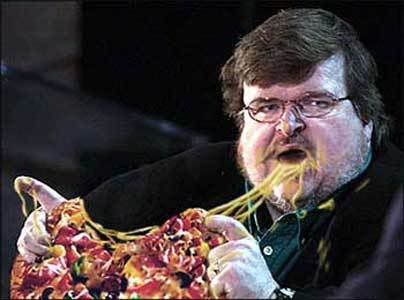
 Last week I ended the blog asking what the general public's opinion on Michael Moore was. Is he saint? Is he the devil? I've already formed my own opinion on him, so I wanted to see what people outside of the classroom thought of him (those who don't have a teacher pointing out all of his fallacies). I found an online poll that was pretty evenly split down the middle. I decided to ask the same question on yahoo answers. I was hoping that the question would get a few hits. Unfortunately, it looks like if the question isn't about Michael Jackson, nobody on Yahoo! Answers cares. The general consensus seems to be a pretty even split, with political parties not really playing a huge role in opinions. Liberals that have really taken the time to analyze his works have a negative opinion on him, and some conservatives think his movies are clever. When I looked on the internet to get some more opinions, the search was just too vague to yield any usable results.
Okay, so this past week we finally wrapped up Bowling For Columbine. What stuck out the most during the final scenes was Mr. Moore's interview with Charlton Heston. A year after the interview, Heston was diagnosed with Alzheimer's, still prior to the release of the film. During the interview, Moore twists Heston's words in different ways, at one point making Heston looking like a racist pig. The movie fails to state at any point Heston's large involvement in the Civil Rights Movement in the 1960's. The questions asked were mainly rhetorical or worded in such a way to even confuse the most prepared interviewee. After previously answering Moore several times, Heston still finds himself being asked "why we were the only country that kills each other at such a large capacity with guns." Not only is the question a fallacy of a complex question (Moore assumes that Heston agrees that there is a large level of violence because he answered the question), but he also asks it multiple times until he gets a controversial answer.

Another scene that stuck out was when Moore went to K-Mart with two victims of the Columbine Massacre. It was probably one of the most blatant examples of the Guerrilla Interview expressed in the film. Moore and the students entered K-Mart headquarters unannounced demanding to see the president of the company. When a manager stepped in the line of fire, she found herself unprepared to answer any of Moore's questions. Although she handled the situation at hand as logically and as well as she could, the interview still made her look bad, which was Moore's main goal in the first place. A day later, when Moore returns with the media and a van full of ammunition, K-Mart felt obligated to issue a public statement. The vice-president barely started her statement before Moore kept interupting her with ambiguitious statements that were only meant to confuse her and make him look good.
Now that we're done with Michael Moore's side of this study, I'm interested to find out what the opposite side is like. Will the director of Michael Moore Hates America use the same techinques we just witnessed in Bowling for Columbine? Will he fall into the same usage of manipulation that he's pointing out and disproving? Hopefully not, but we'll have to wait to find out.
Sources:
Cooper, Scott. "What do you think of Michael Moore?" Yahoo! Answers - Home. Web. 11 Oct. 2009. .
Michael Moore and Pizza. Photograph. Photobucket. Web. http://media.photobucket.com/image/michael%20moore%20sucks/Opinionnation/michael-moore-pizza.jpg.
"Poll: What is your opinion on Michael Moore?" City-data.com. Web. http://www.city-data.com/forum/politics-other-controversies/92008-poll-what-your-opinion-michael-moore.html.


No comments:
Post a Comment